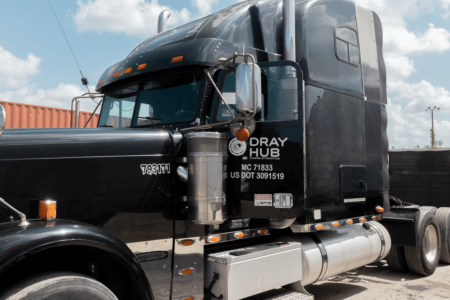
Search for “drayage” and you’ll get two sets of results that have almost nothing to do with each other. One is about shipping containers moving between ports and warehouses. The other is about crates moving from a loading dock to a booth at a convention center.
Both uses are correct. They come from the same old word for a short-haul cart, and they diverged into two separate industries with separate vendors, separate pricing models, and separate vocabularies. If you’re buying the wrong one, this is where the confusion usually starts.
Port drayage: the container leg
In ocean freight, drayage is the short truck move that connects the marine terminal to everything else — a warehouse, a rail ramp, a transload facility, or a container yard. It’s the first or last road segment of an international shipment.
What defines it:
- The unit is a container. A 20, 40, or 45-foot ocean container on a chassis.
- The distance is short. Usually local or regional, often under 100 miles.
- The clock matters. Terminal free time, last free day, and per diem on the ocean carrier’s equipment all run against you.
- Access is credentialed. Drivers need a TWIC card; carriers need UIIA participation to interchange equipment.
- Pricing is a base rate plus accessorials — chassis, waiting time, pre-pulls, storage.
If you have a bill of lading, a container number, and a terminal, this is your drayage. Our primer on what container drayage is covers the mechanics, and six types of drayage services breaks down the variants.
Trade show drayage: material handling at the venue
In the exhibition industry, drayage — increasingly called “material handling” — is the service of receiving your freight, storing it before the show, delivering it to your booth, storing the empty crates during the show, and returning everything afterward.
What defines it:
- The unit is crates, pallets, and cases. Not containers.
- The distance is tiny. Sometimes only from an advance warehouse across town, sometimes just from the marshalling yard to the hall floor.
- The vendor is chosen for you. Show organizers appoint a general services contractor, and you generally cannot bring your own material handler onto the show floor.
- Pricing is by hundredweight (per 100 lbs), with minimums, and with different rates for advance warehouse versus direct-to-show delivery.
Exhibitors are often surprised by the cost, because it’s priced by weight rather than by distance and the physical move can be a few hundred feet.
Where the two actually meet
They intersect more often than you’d think, particularly in a city like Miami with a heavy events calendar and a major seaport.
If your exhibit materials, product samples, or display equipment arrive by ocean container from overseas, you need both. Port drayage moves the container from PortMiami or Port Everglades to a facility where the crates come out. Then the crates ship to the show’s advance warehouse, where the general services contractor’s material handling takes over.
The handoff point is a transload or deconsolidation step, and getting it right matters because the two systems have incompatible deadlines. The show has an advance-warehouse cutoff, typically weeks before opening. The ocean container has free time measured in days. You cannot hold a marine container until the show’s deadline without paying substantially for the privilege.
The practical sequence
- Container arrives and clears customs
- Port drayage pulls the container promptly — before last free day, not before the show deadline
- The container is devanned at a transload facility; crates are inspected and re-labeled for the show
- The empty container goes back to the terminal, stopping per diem
- Crates ship on domestic equipment to the advance warehouse on the show’s schedule
- The show’s appointed contractor handles delivery to the booth
Steps 1 through 4 are the part a container drayage carrier handles. Our overview of container transloading in Miami covers the devanning step in detail.
Which vendor do you call?
A quick test:
- Do you have a container number? You need port drayage.
- Do you have a booth number? You need the show’s material handling contractor.
- Both? You need port drayage first, a transload in the middle, and the show contractor last.
One more distinction worth knowing: nobody in the exhibition world can help you with a demurrage problem, and nobody in the container world can get a crate onto a show floor. These are genuinely separate supply chains that happen to share a word.
Importing exhibit freight through South Florida
Miami’s convention and event calendar — boat shows, art fairs, trade expos — pulls a steady stream of international exhibit freight through PortMiami and Port Everglades. The recurring failure mode is the same every time: the container arrives, the exhibitor plans to hold it until the show, and demurrage and per diem eat the budget.
The fix is to decouple the two clocks. Pull the container, devan it, return the empty, and store crates as ordinary palletized freight until the show’s window opens. Go Drayage runs a five-acre secured Miami yard with 24/7 access and transload equipment for exactly this kind of handoff — see our Miami container drayage for the details.
Frequently asked questions
Why is trade show drayage so expensive for such a short move?
It’s priced by weight rather than distance, and the price bundles receiving, storage before and during the show, delivery to the booth, empty crate storage, and outbound handling. The truck move itself is a small part of what you’re paying for.
Can I use my own trucking company for trade show material handling?
Generally no. Show organizers appoint an exclusive general services contractor for on-floor material handling. You can usually choose your own carrier to deliver to the advance warehouse or marshalling yard, but the final leg onto the show floor is the contractor’s.
Can an ocean container be delivered straight to a convention center?
Almost never, and it’s rarely a good idea even where it’s allowed. Venues aren’t set up to devan containers, the marine equipment stays on per diem the whole time, and show deadlines don’t align with terminal free time. Transload the freight first.