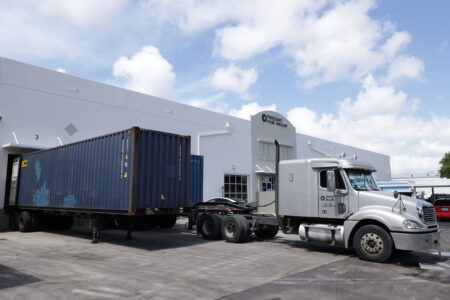
Two deepwater ports, thirty miles apart. A drayage-side comparison of PortMiami and Port Everglades to help you pick the right gateway.
PortMiami vs. Port Everglades: Which Should You Import Through?
PortMiami vs. Port Everglades: Which Should You Import Through?
South Florida has two deepwater container ports roughly thirty miles apart. For a lot of importers the choice between them is made by whoever booked the ocean freight, and never revisited. That is a missed opportunity, because the two ports have genuinely different characteristics and the right answer depends on where your cargo is going and what it is.
This is a practical comparison from the drayage side — not a ranking.
The basic geography
PortMiami sits on Dodge Island, immediately east of downtown Miami, connected by a tunnel that routes port truck traffic directly to the interstate rather than through downtown streets. It is closest to the industrial corridor of Medley, Hialeah, and Doral.
Port Everglades sits in Fort Lauderdale, adjacent to Fort Lauderdale-Hollywood International Airport, and serves Broward and Palm Beach counties more directly.
Thirty miles sounds trivial until you account for I-95 or the Turnpike in traffic. For a drayage move, the difference between a twenty-minute run and an hour-long run is real money and a meaningful chunk of a driver’s day.
The distance question is usually decisive
Drayage is priced substantially on distance and driver time. If your warehouse is in Medley, PortMiami is almost always the cheaper import gateway. If your facility is in Pompano Beach or Riviera Beach, Port Everglades is. Our posts on Miami drayage delivery zones and drayage near Fort Lauderdale and Port Everglades break the local geography down further.
That sounds obvious, and yet a substantial number of containers land at the port that was convenient for the ocean carrier and then get trucked past the other one.
Where they differ beyond distance
Service coverage
Not every ocean carrier calls both ports, and the Caribbean, Latin American, and transatlantic service mixes are not identical. If your origin only has good service into one of them, the decision is made for you.
Cargo mix and facilities
Both handle containers, but the surrounding ecosystems differ. Port Everglades has significant petroleum and cruise activity alongside containers; PortMiami has a large cruise operation and a container terminal footprint constrained by island geography. What matters to you practically is whether the specific handling you need — refrigerated plugs, out-of-gauge capability, particular exam facilities — is available where your box is landing.
Gate hours and congestion patterns
Turn times at both ports vary with vessel schedules rather than being consistently better at one. What is useful is knowing that they do not peak simultaneously, so a carrier working both has flexibility a single-port carrier does not.
Exam and inspection facilities
If your cargo is likely to be selected for examination, where the exam facility sits relative to the terminal affects both cost and delay. Our post on customs exams for Miami importers covers the process.
When to actually change ports
Switching gateways is worth considering when:
- Your distribution has moved, and you are consistently trucking past one port to reach the other
- You are opening a Broward or Palm Beach facility and still importing through Miami, or vice versa
- Your volume is high enough that a per-container difference of even a modest amount compounds meaningfully
- Congestion at your usual gateway has become a persistent rather than occasional problem — see port congestion strategies
It is not worth considering for a single shipment, because changing an ocean routing has its own costs and lead time.
The split-gateway option
Larger importers with distribution in both Miami-Dade and Broward sometimes route deliberately: Miami-bound inventory through PortMiami, northern inventory through Port Everglades. This only works if your drayage carrier operates at both terminals without treating one as an exception, and if your ocean carrier offers comparable service into both.
Go Drayage works both PortMiami and Port Everglades from a five-acre yard in Miami with capacity for roughly 450 containers and trailers, which is what makes the split practical rather than a coordination headache. Our PortMiami and Port Everglades drayage post covers how we handle both.
The honest summary
Neither port is better. For most South Florida importers the correct gateway is simply the one closer to where the cargo is going, provided your ocean carrier serves it well. The importers who get this wrong are usually the ones who set up their routing years ago and never revisited it after their warehouse moved.
If you want a straight comparison of what your specific lanes would cost from each terminal, request a quote with both origins.
Frequently asked questions
How far apart are PortMiami and Port Everglades?
Roughly thirty miles along the I-95 and Turnpike corridor. For drayage that is a meaningful difference in driver time and cost, which is why the closer port to your delivery point is usually the better gateway.
Can one drayage carrier serve both ports?
Yes, and for South Florida importers it is worth insisting on. A carrier that works both terminals gives you flexibility when one is congested and lets you split routing between Miami-Dade and Broward distribution.
Should I choose my port before booking ocean freight?
Ideally yes, because the port of discharge is set at booking and changing it afterward is expensive. Work out where the cargo is actually going first, then book the ocean leg into the gateway closest to it.