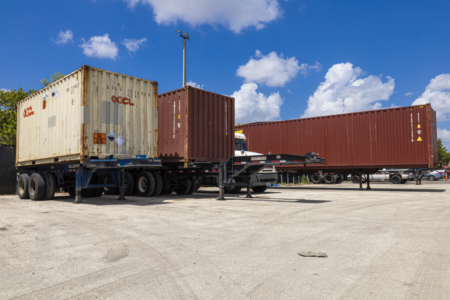
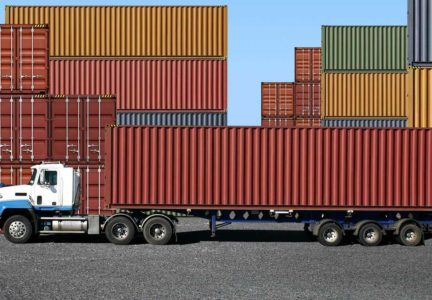
What a peel-off pile is, when it beats appointment-by-appointment drayage, what it costs, and whether South Florida import volumes justify one.
Peel-Off Piles in Drayage: How High-Volume Importers Beat the Gate Queue
Peel-Off Piles in Drayage: How High-Volume Importers Beat the Gate Queue
If you import enough containers through a single terminal, sooner or later someone will suggest a peel-off pile. It sounds like jargon, and it is, but the underlying idea is simple and it can materially change your cost per container. It can also be a poor fit that ties up capital and yard space for no benefit. Here is how to tell the difference.
What a peel-off pile actually is
In normal import drayage, every container is dispatched individually. A driver is assigned a specific container number, books an appointment for that container, and the terminal digs it out of the stack. If that box is buried, the turn takes longer. If the appointment slot is gone, the move slips a day.
In a peel-off arrangement, the terminal segregates a block of your containers into a dedicated pile. Trucks arrive without a container-specific assignment and simply take whatever is on top of the pile — they “peel” it off. The terminal does no digging. The driver does no waiting for a specific box.
The trade is straightforward: you give up control over the order in which containers arrive, and in exchange you get much faster, much more predictable turn times.
Related terms you will hear
- Free-flow. Often used interchangeably with peel-off. Technically it refers to the terminal releasing containers in stack order without appointments tied to specific units.
- Sweep. Clearing an entire block of containers off the terminal in a compressed window, usually to avoid demurrage.
- Dray-off. Moving containers to an off-dock yard for later delivery rather than direct to the consignee.
When a peel-off pile pays off
Three conditions usually need to be true at the same time:
1. Volume concentrated on one vessel or one terminal
Peel-off economics depend on scale. Terminals generally want a meaningful block — commonly in the range of a few dozen containers from the same importer on the same vessel — before they will segregate a pile. Twenty boxes spread across three vessels and two terminals will not qualify.
2. Your cargo is fungible on arrival
This is the condition that kills most peel-off programs. If container HLXU1234567 holds the SKUs your distribution center needs Tuesday and the rest can wait, you do not have a fungible pile — you have a sequencing requirement. Peel-off works best when the containers are interchangeable from a receiving standpoint: same commodity, same destination, no appointment-driven retail delivery windows.
3. You have somewhere to put them
A peel-off sweep pulls containers off the terminal faster than a consignee can typically unload them. You need a staging yard. Without one, you have traded demurrage for detention and per diem, which is rarely an improvement. Our off-dock container storage in Miami exists largely for this reason — to absorb the gap between terminal release and receiving capacity.
What it costs
Peel-off is not free. Expect some combination of:
- A terminal segregation or handling fee per container
- Yard storage for the staged containers
- A second move from the yard to the final consignee
- Chassis costs for the staging period, unless you are grounding the boxes
Against that, you are saving: demurrage on containers that would have sat past last free day, driver wait time at the gate, missed-appointment redelivery, and the per-container premium carriers charge for slow terminals. The comparison only works if you price both sides honestly. Understanding demurrage versus detention versus per diem is essential here, because a peel-off program shifts costs between those three buckets rather than eliminating them.
How it works in South Florida
PortMiami and Port Everglades are not Los Angeles or Savannah. Volumes per importer are generally smaller, vessel calls are more frequent, and free time is often adequate for a well-run import program. That means fewer South Florida shippers hit true peel-off scale.
What is far more common here — and often achieves most of the benefit — is a coordinated sweep: booking a concentrated block of appointments across one or two days, pulling the containers to an off-dock yard, and delivering on the consignee’s schedule from there. It is not a formal peel-off arrangement with the terminal, but it accomplishes the same thing for a fleet that can surge trucks.
That approach depends entirely on the carrier having its own equipment and yard rather than brokering the work out. If you are evaluating carriers on this capability, our guide on how to choose a drayage carrier covers the questions worth asking.
Common mistakes
- Assuming the terminal will agree. Pile segregation consumes terminal real estate. It is negotiated, not requested.
- Forgetting the empties. A sweep creates a matching wave of empty returns days later, and empty return appointments are frequently the harder constraint.
- Ignoring customs status. Containers under exam or hold cannot be peeled. They will fragment the pile and drag the program’s economics down.
- No unload plan. Moving boxes fast is only valuable if you can devan them.
The practical takeaway
Peel-off is a volume tool, not a universal best practice. If you are running fewer than roughly thirty interchangeable containers off a single vessel, your leverage is better spent on tighter appointment discipline, earlier customs clearance, and a staging yard close to the terminal. If you are above that threshold and your cargo is genuinely fungible, it is worth a conversation with both your terminal and your carrier.
Go Drayage runs company-owned tractors and a five-acre secure yard minutes from PortMiami, which is what makes concentrated pulls workable. Talk to our team about your vessel schedule and we will tell you honestly whether a sweep would help.
Frequently asked questions
How many containers do you need for a peel-off pile?
There is no universal number, and it is set by the terminal, not by regulation. In practice, importers generally need several dozen containers from the same vessel before a terminal will consider segregating a dedicated pile. Smaller volumes are usually better served by a coordinated appointment sweep.
Does peel-off eliminate demurrage?
It reduces the risk substantially by removing appointment and dig-out delays, but it does not eliminate the charge. Containers still accrue demurrage after last free day if they are not moved, and customs holds will keep individual boxes on the terminal regardless of the pile arrangement.
Can peel-off work if my containers have different delivery destinations?
Yes, provided you stage the containers at an off-dock yard first. The pile gets you off the terminal quickly; the yard lets you re-sequence deliveries by destination afterward. Without the staging step, mixed destinations make peel-off impractical.