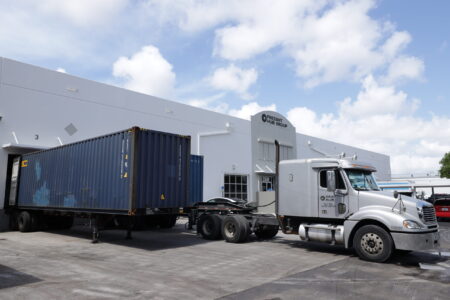
One container, two consignees, one truck. It sounds simple and it is the request that most often goes wrong. Here is how to structure it.
Split Deliveries: Unloading One Container at Two or More Stops
Split Deliveries: Unloading One Container at Two or More Stops
A container arrives with product for three locations – your main warehouse, a retail stockroom, and a customer who bought a portion of the shipment. The obvious plan is to have the truck stop at each one.
Split deliveries are a routine request and they are entirely workable, but they fail more often than straight deliveries because of assumptions nobody checks. Here is how they actually run.
What a split delivery physically involves
The container stays on the chassis. The driver arrives at stop one, the consignee removes their portion, the doors close, and the driver moves to stop two. Nothing gets rehandled by the carrier – each consignee unloads their own goods out of the same box.
Three consequences follow from that, and they are the source of most problems:
- Loading order determines unloading order. Whatever is nearest the doors comes out first. If stop three’s goods were loaded last at origin, stop three must be visited first – or someone has to unload and reload stop one’s freight to reach it.
- Every stop is billable time. The truck and driver are committed for the full sequence. A delay at stop one delays everything behind it.
- The seal is broken once. After the first stop, the container is open. Chain of custody from that point rests on the parties handling it, which matters for claims and for any cargo with security requirements.
The loading-sequence problem, in detail
This is the single most common reason split deliveries go badly. The container was packed at origin by someone who had no idea it would be split, and it was packed for space efficiency.
If you know at booking time that a container will be split, tell the supplier how to load it: last stop loaded first, deepest in the box; first stop loaded last, nearest the doors. Ask for a load plan or a stow diagram confirming it.
If you do not know until the container is on the water, get the packing list and figure out the practical unload order before you sequence the stops. Guessing at the terminal gate does not work.
How split deliveries are priced
Expect the structure to be a base drayage rate to the first stop, plus a per-stop charge for each additional location, plus free time per stop with detention beyond it. Mileage between stops may be separate depending on how far apart they are.
The variable that moves the number most is not distance – it is time. Two stops within a few miles of each other that each unload in thirty minutes is an easy move. Two stops twenty miles apart that each take two hours is a full day of a truck’s capacity, and it prices that way.
When you request a quote, give the carrier the addresses, the approximate volume at each stop, and the expected unload time at each. Our drayage quote checklist covers the rest.
Per diem does not pause between stops
The ocean carrier’s clock on the container runs from the moment it leaves the terminal until the empty is returned. A split delivery spread across two days consumes two days of per diem plus two days of chassis, on top of the extra stop charges.
This is why a split delivery that runs over into a second day is disproportionately more expensive than one completed in a single shift. If the stops cannot realistically be completed in one day, consider whether a different structure is cheaper.
When a transload beats a split delivery
Transloading means stripping the container at a facility near the port and delivering each portion on a separate, appropriately sized truck. It costs more in handling and it makes sense surprisingly often.
Choose a transload when:
- There are more than two or three stops.
- Stops are far apart, or in different counties.
- Any stop cannot physically receive a container-on-chassis – retail back lots, urban stockrooms, residential-adjacent sites.
- The loading order is wrong and cannot be fixed.
- Delivery dates differ – one stop needs it today, another next week.
- The container needs to go back fast to control per diem.
Choose a split delivery when there are two stops, they are close together, both can take a container, both can unload quickly, and the load order cooperates.
Our container transloading guide covers the handling side, and transloading vs. cross-docking explains the distinction if your freight is already sorted by destination.
Documentation for multiple consignees
One container usually means one bill of lading and one customs entry, even when the goods belong to several parties. That has implications:
- The importer of record is one entity, responsible for the whole entry.
- Delivery receipts should be issued per stop, with piece counts recorded at each, so a shortage can be located rather than argued about.
- Seal integrity is verifiable only up to stop one. Record the seal number and condition there.
- If any portion is sold to another party, settle who bears risk once the doors first open.
Get piece counts signed at every stop. Without them, a discrepancy discovered at the last stop is unresolvable.
Sequencing the stops
Work through these in order when planning:
- Establish the physical unload order from the packing list or stow plan.
- Check each site can receive a container on a chassis – access, turning room, dock or ground-level equipment.
- Confirm receiving hours at every stop, and confirm they overlap with a single driver shift.
- Book appointments at each, sequenced with realistic travel time between.
- Build in a fallback: if stop one runs long, does stop two still accept a late arrival or does the container go to a yard overnight?
That last point is the one people skip. A split delivery with no fallback becomes an expensive improvisation the first time a forklift breaks. Staging at yard storage overnight is usually cheaper than a failed second stop and a redelivery.
Frequently asked questions
How many stops can one container delivery have?
Technically as many as the day allows, but practically two is comfortable and three is the point where a transload usually becomes the better option. Each stop adds fixed time, and the risk of the sequence failing compounds with every additional location.
What happens if the goods for the second stop are loaded behind the first stop’s freight?
Either the stop order is reversed, or the first consignee has to unload and reload goods that are not theirs – which most will decline. If neither works, the container goes to a transload facility where it can be sorted properly. Checking the packing list before dispatch prevents this.
Is a split delivery cheaper than two separate container moves?
Almost always, if the goods were in one container to begin with, since you are paying one drayage base rate plus a stop charge rather than two full moves. The comparison that matters is against transloading, which trades a handling fee for faster container return and fewer constraints.