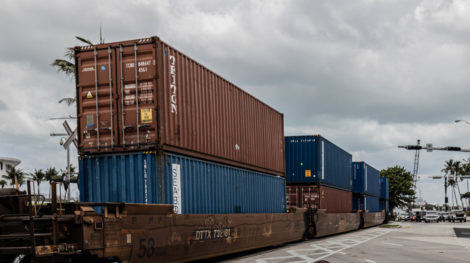
The cube math, the weight ceiling, and the full cost comparison that tells you whether transloading into 53ft trailers actually saves money.
Transloading a 40ft Container into a 53ft Trailer: Does the Math Work?
Transloading a 40ft Container into a 53ft Trailer: Does the Math Work?
Transloading a 40ft ocean container into a 53ft domestic trailer is one of the few moves in logistics where the arithmetic is genuinely simple — and where a lot of importers still get it wrong, because they compare the transload fee to zero instead of comparing it to what they are actually spending on per diem, chassis, and extra linehauls.
The space math
A 40ft high-cube ocean container gives you roughly 2,690 cubic feet of usable space. A 53ft domestic dry van gives you roughly 3,850. That is about 43% more cube per trailer. On pure volume, three 40HC containers consolidate into two 53ft trailers with room to spare — you have replaced three domestic linehauls with two.
Pallet positions tell the same story. A 40ft container typically holds 20 to 21 standard 40×48 pallets on the floor. A 53ft trailer holds 26 pinwheeled, or 30 straight-loaded if your pallets and dock allow it.
The weight ceiling that kills the math
Cube only matters until weight stops you. A 53ft dry van on a standard five-axle configuration is generally limited to somewhere in the 42,000 to 45,000 lb payload range depending on tractor weight and fuel. If your cargo runs dense — tile, stone, beverages, canned goods, machinery parts — you will hit that ceiling with the trailer half empty.
The practical rule: transloading pays on cube-heavy freight and rarely pays on dense freight. Before you run the numbers, calculate your density in pounds per cubic foot. Under roughly 12 lb/ft³ and consolidation almost always wins. Above 20 lb/ft³ and you are paying a handling fee for space you cannot use.
The cost comparison importers actually need
Compare two complete scenarios rather than comparing a transload fee to nothing.
Scenario A — direct drayage in the ocean box
- Drayage from the terminal to the consignee, per container.
- Chassis rental for the entire duration the box is out.
- Per diem on the ocean container from last free day until the empty is returned.
- A second move to return the empty to the terminal.
Scenario B — transload at a Miami facility
- Short drayage from the terminal to the transload yard.
- Transload labor and equipment.
- Immediate empty return — the per diem clock stops days earlier.
- Domestic linehaul in 53ft trailers, on fewer trucks.
The savings in Scenario B come from three places at once: fewer domestic trucks, a much shorter per diem exposure, and no chassis rental running for a week. On a long inland destination the per diem savings alone often cover the transload cost. On a short local delivery in Miami-Dade, they do not.
When transloading is clearly the right call
- Long inland destinations. Ocean containers going to Atlanta, Nashville, or the Northeast carry per diem and chassis costs the whole way, and the empty has to come back.
- Multiple containers to one destination. This is where the 43% cube advantage compounds.
- Multiple destinations from one container. Split the load once at the yard instead of running a milk run with an ocean box.
- Warehouses that cannot take a container. Some docks cannot handle a chassis-mounted 40ft box. A 53ft van backs in normally.
- Tight free time. Transloading gets the empty back fast, which is sometimes the entire point.
Our broader container transloading guide covers the facility side, and the transloading vs cross-docking comparison explains where the two differ.
When it is not
Skip it for dense freight, single containers with local delivery, cargo that is floor-loaded and fragile, and anything where the receiving warehouse is inside Miami-Dade and can take a live unload within free time. In those cases a direct drayage move, or a pre-pull into a yard, is simpler and cheaper.
Doing it in South Florida
Miami’s advantage is proximity. Our five-acre yard is close enough to PortMiami and Port Everglades that the terminal-to-yard leg is short, which is what makes fast empty returns possible. We run 19,000 lb and 40,000 lb forklifts on site and can hold over 450 containers, so a transload does not have to be scheduled around someone else’s dock availability. See our container freight station or request a quote with your cube and weight and we will run the comparison for you.
Frequently asked questions
How many 40ft containers fit into one 53ft trailer?
It depends entirely on whether you are limited by volume or by weight. On light, cube-heavy freight roughly three 40ft containers consolidate into two 53ft trailers. On dense freight you hit the trailer’s weight limit long before you fill the space, and the ratio collapses toward one to one.
Does transloading damage or increase the risk to my cargo?
Every extra handling touch adds some risk, which is why floor-loaded and poorly packaged freight is the worst transload candidate. Palletized, shrink-wrapped freight handled by a facility with the right forklifts transloads with very low incident rates. Ask about equipment capacity and photo documentation before you commit.
Is transloading worth it for a single container?
Rarely. The economics come from consolidating multiple containers into fewer domestic trailers, or from avoiding per diem on a long inland run. For one container going a short distance in South Florida, direct drayage is almost always cheaper.