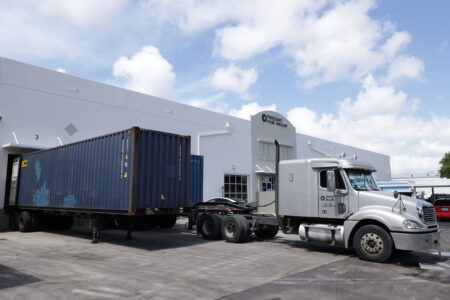
Drop-and-hook vs live unload for container drayage: how each works, cost and time tradeoffs, and when a secure yard makes drop programs possible.
Drop-and-Hook vs. Live Unload in Container Drayage: Which Is Right for Your Freight?
Drop-and-Hook vs. Live Unload in Container Drayage: Which Is Right for Your Freight?
If you move import containers through PortMiami or Port Everglades, one operational decision quietly shapes your drayage costs more than almost any other: does the driver wait while your team unloads the container, or does the driver drop it and leave?
That is the difference between a live unload and a drop-and-hook, and choosing the wrong model for your volume and dock setup can mean paying for hours of driver time you did not need to buy. Here is how each option works, where the costs hide, and when a secure container yard changes the math entirely.
How a live unload works
In a live unload, the driver arrives at your warehouse with the loaded container on a chassis, backs into a dock door, and waits while your crew unloads the freight. Once the container is empty, the same driver hauls it back to the port or a depot to return the empty.
Live unloads are the default for many shippers because they are simple. You need no extra chassis, no spare dock space to park equipment, and no second dispatch. One truck, one move, done.
The catch is the clock. Most drayage carriers include a set amount of free time at the receiver, commonly one to two hours. After that, detention charges accrue, usually billed in increments per hour. A container that takes four hours to floor-unload by hand can quietly double the cost of the move. And if your dock is backed up when the driver arrives, you are paying for wait time before the first carton comes off.
How drop-and-hook works
In a drop-and-hook (also called a drop program), the driver arrives, unhooks the loaded container and chassis at your facility, and either leaves or hooks up an empty container you have finished unloading. Your team then unloads the dropped container on its own schedule, whether that is later that afternoon or overnight.
The benefits show up fast:
- No detention pressure. Your crew unloads at its own pace instead of racing a billing clock.
- Better dock scheduling. Containers wait for doors instead of drivers waiting for containers.
- More efficient trucking. Drivers complete more moves per day, which keeps capacity available during crunch weeks and often keeps rates steadier.
- Overnight and weekend flexibility. A container dropped Friday afternoon can be unloaded Saturday morning without paying a driver to stand by.
The tradeoffs are real, too. Drop programs require space to stage equipment, chassis that can sit at your facility without triggering per-diem problems, and enough volume to justify the round-trip moves. A shipper handling two containers a month rarely needs one. A shipper handling two a day almost certainly does.
The cost and time tradeoffs at a glance
Live unload tends to win when:
- Your volume is low or irregular
- Your crew can reliably unload within the free time window
- You have no room to stage a container and chassis
- The freight is palletized and comes off in under an hour
Drop-and-hook tends to win when:
- Containers are floor-loaded and slow to unload
- You receive multiple containers per week
- Dock congestion makes appointment times unpredictable
- You want to unload nights or weekends without paying detention
The math usually comes down to detention versus the cost of the extra positioning moves. If your average unload runs past free time by two hours or more, a drop program frequently pays for itself.
Driver wait time: the cost nobody budgets for
Detention is the line item that surprises shippers most. It is not just the hourly charge; it is the ripple effect. A driver stuck at a dock for three hours misses a terminal appointment, which can push an empty return past the deadline, which can trigger per diem on the container. One slow unload can cascade into three separate fees.
Wait time also erodes carrier relationships. Drayage capacity in South Florida tightens during peak season, and carriers naturally route their trucks toward shippers whose freight keeps moving. Facilities known for fast turns or clean drop programs get served first when trucks are scarce. If demurrage is part of your cost picture too, it helps to understand how last free day works in drayage, because dock delays at destination often start with pickup delays at the port.
When a secure yard makes drop programs possible
Here is the problem many importers hit: they want the economics of drop-and-hook but have nowhere to put the boxes. Their warehouse has two dock doors, no fenced trailer parking, and a landlord who frowns on containers sitting in the lot.
A carrier-operated container yard solves that. Instead of dropping at your facility, the container is pulled from the port and staged at the yard, then delivered to your dock exactly when a door is open. You get drop-program flexibility without dedicating an inch of your own real estate.
Go Drayage runs a 5-acre secure yard in Miami with 24/7 access and capacity for more than 450 containers and trailers, plus forklifts rated at 19,000 and 40,000 pounds for transloading when it makes more sense to strip the container at the yard and deliver palletized freight instead. For importers whose receiving schedule never quite matches vessel schedules, short- and long-term yard storage acts as the buffer that keeps detention, demurrage, and per diem off the invoice.
Choosing the right model for South Florida freight
There is no universally correct answer, and plenty of shippers run a hybrid: live unloads for fast, palletized containers and drops for slow, floor-loaded ones. The right partner will look at your unload times, your dock schedule, and your weekly volume before recommending a structure.
As an asset-based carrier serving PortMiami and Port Everglades with company-owned trucks and its own yard, Go Drayage can run either model, or both. If you want a straight answer on which setup fits your freight, request a drayage quote or call (786) 445-0150 and walk through your volumes with a dispatcher who moves these lanes every day.
Frequently asked questions
What is the difference between drop-and-hook and live unload in drayage?
In a live unload, the driver waits at your dock while the container is unloaded and then returns the empty. In a drop-and-hook, the driver leaves the loaded container at your facility or a nearby yard and picks up an empty on a later trip, so your team can unload on its own schedule without detention charges.
How much free time do drayage carriers give for a live unload?
Free time varies by carrier and contract, but one to two hours at the receiver is common. After free time expires, detention is typically billed in hourly increments, so slow or floor-loaded containers can add significantly to the cost of a live unload.
Can I run a drop program if my warehouse has no room for containers?
Yes. A carrier with its own secure yard can stage your containers off-site and deliver them when a dock door opens. Go Drayage operates a 5-acre secure yard in Miami with 24/7 access and capacity for over 450 containers and trailers, which lets importers get drop-program flexibility without on-site storage space.