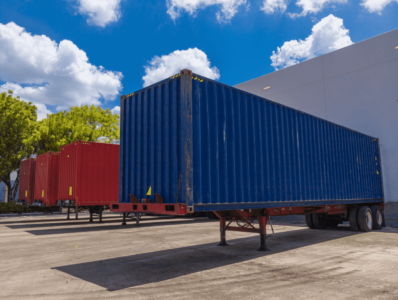
Doral and Airport West hold some of the densest warehouse space in South Florida, and a lot of it was built before 53-foot trailers and container chassis were the default. A box can clear PortMiami clean and still burn two hours at a receiving gate off NW 25th Street because the truck court is 95 feet deep, the leveler won’t reach the container floor, and the receiving office closes at 2:00. The fix is almost always in the planning, not the driving.
Getting there: the routes that actually work
“Doral” on a delivery order can mean anything from NW 87th Avenue to the Turnpike, and from NW 12th Street up to NW 74th. Where the building sits inside that box changes the drive more than the mileage suggests.
From PortMiami
The PortMiami Tunnel puts you on the MacArthur Causeway and I-395, the cleanest way out of the port westbound. From there it’s SR 836 (Dolphin Expressway) west, then NW 87th Avenue, the Palmetto (SR 826), or NW 107th Avenue depending on the building. The 836 is the workhorse for this lane, and its tolls are a real per-move line item worth knowing about when you compare quotes.
Surface-street alternatives — NW 12th, NW 36th, NW 25th Street — are slower, signal-heavy, and some segments carry weight or route restrictions. Miami-Dade designates specific truck routes and residential cut-throughs in Doral are enforced; our breakdown of Miami-Dade truck routes for port drayage covers the corridors drivers actually use.
From Port Everglades
Out of Port Everglades it’s Eller Drive to I-595 west, then the Turnpike or I-75 south into NW Miami-Dade. It’s a longer haul in miles than PortMiami to Doral, but at the wrong hour the 595/Turnpike run is more predictable than fighting 836 at 4:30 p.m. When you have a choice of port, that predictability sometimes matters more than the ocean freight difference.
What Airport West buildings are actually like
This submarket is a mix of 1970s and 1980s light-industrial product and newer cross-dock and bulk distribution buildings. The older stock is where the surprises live.
Dock height and leveler travel
An ocean container riding on a chassis sits higher than a standard dry van floor. Docks built around 48- to 52-inch van decks can run out of leveler travel against a container, leaving the plate at a steep pitch or not reaching at all. That’s a forklift problem before it’s a scheduling problem — a pallet jack may not be able to work that ramp safely. Ask the receiver their dock height and whether their levelers are rated for container work, not just van work.
Truck court depth and turning radius
Modern distribution spec is roughly 130 feet of apron depth so a tractor and 53-foot trailer can square into a 90-degree dock. Plenty of older Airport West buildings were laid out for 40- and 45-foot trailers and give you 100 feet or less, sometimes with parked cars eating the difference. A tractor-and-chassis combination needs the same room a 53-footer does — and you need to know that before the driver is on site, because the options at that point are all expensive.
Appointment windows and receiving hours
Many Doral and Airport West receivers run tight windows — a morning block, a hard last-receiving cutoff mid-afternoon, and no flexibility for a container that hits traffic. Stack that against terminal appointment availability at the port and the day gets narrow fast. Both ends have to line up, and the terminal slot is the one you control least.
Grounding rules
Ask early whether the building allows a drop. Many older Doral facilities have no room to ground a container or park a loaded chassis, which forces a live unload. A live unload means your driver is on the clock while the receiver works the box — and that clock turns into detention charges that were never in the rate.
Why transloading sometimes beats a live delivery
When the building can’t take a container cleanly, the answer is usually to break the container somewhere else and deliver the freight in a form the dock can handle. That means pulling the container to a yard, devanning it, palletizing or re-palletizing, and running the cargo in on a van, a flatbed, or a straight truck sized to the site.
Transloading tends to win when:
- The dock or court can’t take a container on a chassis — low leveler travel, short apron, or a street-side dock with no staging room.
- The receiver unloads slowly. A four-hour floor-loaded devan at the customer’s dock is four hours of driver and chassis time you’re paying for.
- The container is overweight for a direct run. Splitting cargo across two trailers can be cheaper and simpler than chasing an overweight permit and a restricted route.
- Cargo is going to more than one consignee. One container, three Doral stops, three sets of appointment windows — that’s a transload, not a drayage move.
- The container has to go back empty on a deadline and the receiver can’t unload inside the free time. Strip it once, return the box, and deliver the freight on your own schedule.
Go Drayage handles this on a 5-acre secure Miami yard with 24/7 access and room for 450+ containers and trailers, using company-owned trucks, vans, and flatbeds and forklifts rated to 19,000 lb and 40,000 lb. Our Miami container transloading guide walks through what the process costs you in time and what it saves.
The clock you’re actually racing
Two meters run at once on a Doral delivery. The terminal’s free time on the container, and the equipment provider’s per diem on the chassis. Both keep running while a receiver takes three days to give you a receiving appointment. If you know the building is slow, pull the box early, stage it off-dock, and deliver into their window instead of paying the terminal to store your cargo. Published starting drayage rates on this site run from $500 at PortMiami and from $450 at Port Everglades, but actual pricing depends on the move — weight, distance, wait time, chassis days, and whether a transload is in the middle.
Planning a Doral or Airport West delivery
Send the receiver’s address, dock and court details, receiving hours, container size and weight, and your last free day. That’s enough to tell you whether it’s a straight live delivery, a drop, or a transload — before a driver is sitting in a truck court that won’t take him. Request a drayage quote or call (786) 449-4020.
Frequently asked questions
How long does a container take from PortMiami to Doral?
The drive itself is short — typically under an hour outside peak hours via the PortMiami Tunnel, I-395 and SR 836. The variable is not the drive, it is the terminal appointment, the gate queue, and the receiver’s window. Plan the day around those three, not around the mileage.
Can any Doral warehouse take a 40ft container at the dock?
No. Older Airport West buildings often have truck courts under 100 feet and dock levelers set up for van trailers, not containers on chassis. Confirm apron depth, dock height, and whether the site allows a drop before booking a live delivery.
Is transloading cheaper than delivering the container directly?
Sometimes. Transloading adds a handling step but removes driver wait time, chassis per diem days, and the risk of a truck that cannot dock. It usually wins when the receiver unloads slowly, the site cannot take a container, or the cargo splits between multiple consignees.