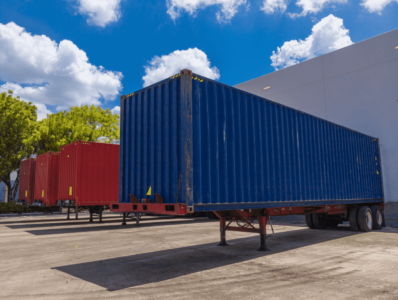
An ocean container has been through a crane, a ship’s rolling, a chassis, and a highway before it reaches your dock, and nothing inside is necessarily where the shipper left it. The two moments that hurt people are when the doors open and when a forklift is deep inside the box. Control those, and document what you see before you touch anything.
Before the doors open
Walk the box first. Check the seal number against your delivery order and bill of lading, and photograph it intact before cutting. Look for a fumigation placard — a treated container must be ventilated and cleared before entry, and that is not a call for your receiving clerk to make on the spot. Then look for staining on the doors, a bulge in the panels, or cargo pressing against the door seal. Any of those means the load shifted at sea.
Check the container itself too: roof and side panel damage, a bent door frame, standing water. Know the box weight if you have it — it affects dock plate loading and how the chassis behaves as you strip it.
Opening the doors without getting hit
Door injuries come from two sources: pressure from a shifted load, and the locking bars themselves swinging under tension.
- Stand to the side of the door, never in front of it — outside the arc of the door and the fall line of the cargo.
- Open the right-hand door first (the one without the overlap), a few inches at a time, and look before committing.
- Keep hold of the locking bar. A bar under pressure snaps outward. Both hands on it, feet set, and never let it go free.
- Use a strap or rope when you suspect a shifted load, so you can crack the door from a distance.
- If cargo is leaning on the door, stop. Rig the doors closed, get a supervisor, and plan a controlled opening — sometimes that means working the load from the top rather than the face.
- Clear the walkway behind you before you start. Nobody stands in the blast zone.
Securing the box: dock locks, landing gear, creep
Every forklift pass pushes the container away from the dock a fraction of an inch. A few hundred passes and you get trailer creep — the gap opens, the dock plate loses purchase, and a forklift goes into the hole. It is one of the more common fatal loading-dock mechanisms and it is entirely preventable.
- Use a vehicle restraint (dock lock) where you have one, chocks where you don’t. OSHA’s powered industrial truck rules require trailers to be secured against movement during loading and unloading; a mechanical restraint that actually prevents movement is the accepted alternative to chocking.
- Never rely on the tractor’s brakes alone, or on the driver’s word that he’ll stay put.
- Support a dropped chassis properly. Landing gear needs solid ground, not soft asphalt or a drain cover, and jack stands under the nose. A rear-heavy container can tip as a forklift enters, and the center of gravity moves the whole time you strip it.
- Check the dock plate every cycle. A container on a chassis rides higher than a van trailer, steepening the plate angle beyond what your equipment may be rated to climb under load.
Inside the box
Heat and air
A closed steel container in Miami sun runs far hotter than the outside air — hot enough that an hour inside is a real heat-illness risk in summer, not a comfort complaint. Open both doors, ventilate before entry, rotate people out, and keep water at the dock. Watch your crew for confusion and irritability; those show up before collapse.
Air quality is the other half. A box sealed for weeks can hold residual fumigant, cargo off-gassing, or depleted oxygen. Add an idling propane or diesel forklift and you have a carbon monoxide problem — electric equipment is the right answer for deep container work.
Dunnage and bracing
Ocean loads are braced with airbags, wood blocking, and steel or polyester strapping. Strapping under tension whips when cut — cut at the anchor, from the side, eye protection on. Deflate airbags rather than puncturing them near a face. Pull blocking out as you go instead of piling it at the doors, and decide where the dunnage goes before you start.
Floor condition
Container floors are wood or bamboo laminate and they take abuse. Look for soft spots, lifted boards, protruding nail heads, and spill residue from a previous load. They are engineered around a limited forklift axle load, and a heavy lift truck carrying a heavy pallet can exceed it — know what your equipment weighs, not just what it lifts.
Forklift limits in a container
A 40-foot standard gives you roughly a 7’5″ door opening; a high cube roughly 8’5″. A standard triplex mast does not fit — container work needs a low-profile or free-lift mast, and the operator needs to know the mast height, not guess it.
- Rated capacity drops as load center extends. A truck rated at a 24-inch load center loses capacity fast with long forks or an attachment. Read the data plate for the configuration you’re actually running.
- The last third of the box is the hard part. Poor visibility, no room to turn, and a long reverse with a raised load — travel low.
- Nobody works on foot inside the box while a forklift is in it. If hand-stacking is required, the forklift stays out.
If the load is floor-loaded, heavy, or awkward, stripping it in a facility with rated equipment beats fighting it at a receiving dock — our breakdown of container destuffing and devanning covers what that involves.
Document damage before you touch the freight
The most expensive mistake in receiving is unloading a damaged container first and documenting second. Once cargo is on your floor, proving where the damage happened gets very hard.
- Photograph the intact seal with its number readable, the closed doors, and the first view of the load before anything moves.
- Photograph water staining, crushed cartons, shifted stacks, and container damage.
- Note exceptions on the delivery receipt before signing — carton counts, condition, location in the box.
- Keep the seal, and notify your carrier and insurer promptly. Ocean cargo claim windows are short and concealed damage has its own deadline; check your bill of lading terms.
Careful unloading also costs the driver time, and that time gets billed — see our note on driver detention during warehouse unloading if your unloads regularly run long.
When the dock isn’t the right place
Some containers should not be stripped at a receiving dock at all — heavy, out-of-gauge, damaged, or simply too slow for the building. Go Drayage devans containers at our Miami facility with forklifts rated to 19,000 lb and 40,000 lb, then delivers the freight in a form your dock can handle. See our container freight station services or call (786) 449-4020.
Frequently asked questions
What is the safest way to open a shipping container door?
Stand to the side rather than in front, open the right-hand door first, keep both hands on the locking bar so it cannot swing free, and crack it a few inches before committing. If cargo is pressing on the door or the panel is bulging, stop and plan a controlled opening with a strap or rope from a safe distance.
What is trailer creep and how do you prevent it?
Trailer creep is the gradual movement of a trailer or chassis away from the dock caused by the repeated force of forklifts entering and exiting. Prevent it with a vehicle restraint or dock lock, wheel chocks where no restraint exists, and by checking dock plate engagement each cycle rather than relying on the tractor’s brakes.
Should I unload a damaged container before or after documenting it?
Document first. Photograph the intact seal with its number readable, the closed doors, and the first view of the load before anything moves, then note exceptions on the delivery receipt before signing. Once the freight is on your floor, proving where the damage occurred becomes very difficult.