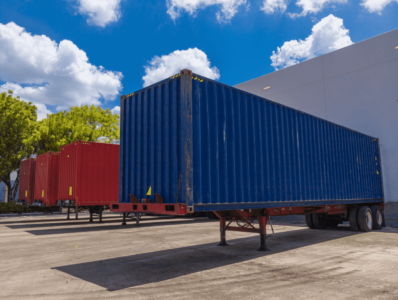
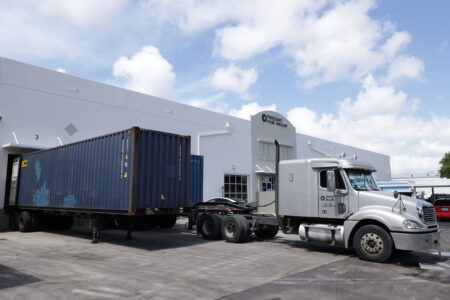
Tile, stone, and fixtures arrive heavy and go to jobsites, not warehouses. How to dray and stage construction imports in South Florida.
Drayage for Construction Materials Importers in South Florida
Drayage for Construction Materials Importers in South Florida
South Florida builds constantly, and a large share of what goes into those buildings arrives in a container. Porcelain tile, natural stone, cabinetry, fixtures, glass, steel, prefabricated components — the region’s construction supply chain runs through PortMiami and Port Everglades.
Construction freight is also some of the hardest cargo to dray well. It is heavy, it is fragile in ways that are not obvious, and it is going to a jobsite rather than a warehouse. Each of those creates a specific problem.
Problem one: the weight
Tile and stone are among the densest things that move in containers. A 20ft container of porcelain tile can reach the ocean carrier’s maximum gross weight while looking half empty.
The consequence is that a large fraction of construction containers are effectively overweight for standard highway equipment. They need a tri-axle chassis, sometimes a permit, and always a carrier who knew about the weight before dispatch. Our guide to overweight container drayage in Florida covers the equipment and permitting side in detail.
The practical rule: send the verified gross mass with the quote request, every time. A container that turns out to be heavy on pickup day is a delayed container.
Problem two: the destination is a jobsite
Warehouses have docks, forklifts, and staff. Jobsites frequently have none of those, and the ones they do have are shared across trades.
Realistic constraints at a construction delivery:
- No dock. Ground-level unloading only, which is slower and needs a forklift that can reach into a container.
- Limited access. Urban sites in Miami, Fort Lauderdale, and West Palm Beach often have narrow approaches and no room to turn a chassis.
- Delivery windows. Many municipalities and sites restrict truck deliveries to specific hours.
- Nowhere to store. A jobsite that is not ready cannot take material, and material sitting on a site is material that gets damaged or stolen.
- Sequencing. Tile is needed after drywall, not before. The container arriving on schedule is not the same as the material being needed on schedule.
That last point is the one that drives the entire strategy.
Problem three: fragility
Stone slabs crack. Tile chips. Glass does what glass does. Construction material damaged in transit is not just a replacement cost — it is a lead time, and a lead time on an import is measured in weeks.
This argues for fewer handling events and better equipment, not for the cheapest quote.
The pattern that works: stage, then release
Trying to time a container’s arrival from overseas to a jobsite’s readiness is a losing game. Vessels slip. Construction schedules slip more. The two will not line up.
The approach that consistently works is to decouple them:
- Pull the container from the terminal quickly so demurrage stops accruing.
- Stage it locally — either intact on a secured yard, or stripped and palletized under cover.
- Release material to the site as the schedule actually calls for it, in truckloads the site can handle.
- Return the empty early so per diem is not running for weeks while the site catches up.
Go Drayage’s five-acre Miami yard holds roughly 450 containers and trailers with 24/7 access, and runs 19,000 and 40,000 lb forklifts for heavy transloading. Details are on the yard storage and container freight station pages.
For material too large or heavy to break down — structural steel, oversized equipment, out-of-gauge components — the heavy hauling side handles what a standard chassis cannot.
What to tell your carrier
Construction deliveries go wrong for informational reasons more than operational ones. Send:
- Verified gross mass of each container
- Whether the site has a forklift and what it is rated for
- Ground-level or dock
- Site access constraints — approach, turning room, overhead clearance
- Permitted delivery hours
- Site contact who will actually answer a phone
- Whether material can be staged elsewhere if the site is not ready
Seven fields. They prevent the majority of failed construction deliveries.
A note on timing risk
Construction schedules compress toward the end of a project, which means the containers that matter most tend to arrive when there is the least slack. Building buffer into the drayage plan — a staging position, a carrier with capacity, a known fallback — is cheaper than expediting a replacement shipment from overseas.
If you are importing materials for South Florida projects and want the drayage and staging handled together, request a quote with the container weights and the site details included.
Frequently asked questions
Can a container be delivered directly to a construction site?
Sometimes, if the site has forklift capacity, room to manoeuvre a chassis, and permitted delivery hours. Many urban sites do not, which is why staging material nearby and releasing it in site-sized loads is the more common approach.
Why are tile and stone containers usually overweight?
Because they are extremely dense. A container can reach the ocean carrier’s maximum gross weight while appearing only partly full, which frequently puts it above what standard highway equipment can legally carry.
How do I avoid demurrage when my jobsite is not ready?
Pull the container from the terminal on time and stage it on a secured yard or transload the material into local storage. Demurrage stops when the box leaves the terminal, so the delay moves to a location where it costs far less per day.