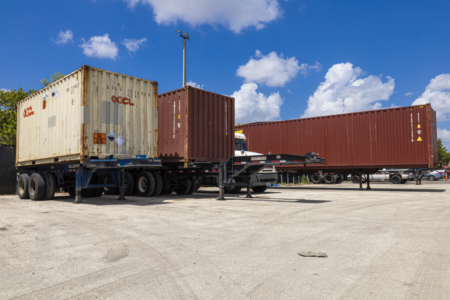
Drayage for personal effects and household goods containers in South Florida — customs requirements, residential delivery limits, timing and cost drivers.
Household Goods Container Drayage in Miami: Moving a Home by Sea
Household Goods Container Drayage in Miami: Moving a Home by Sea
Miami is one of the busiest gateways in the country for household goods moving by ocean container — families relocating to and from Latin America and the Caribbean, expatriates returning home, retirees moving south, and international assignees rotating through. The ocean leg is usually handled by a moving company or forwarder. The trucking leg often is not, and that is where these moves get complicated.
Personal effects containers are not like commercial cargo. The paperwork is different, the delivery environment is residential, and the consignee is a person rather than a receiving department.
What makes personal effects different
Customs treatment
Used household goods and personal effects can enter duty free under specific conditions — broadly, that the items were owned and used abroad by the importer and are being imported in connection with the owner’s arrival to reside in the United States. The rules have real requirements around ownership period, the owner’s presence, and what qualifies.
The practical drayage implication: these containers are examined more often than commercial freight, and the paperwork — the CBP declaration, a detailed inventory, passport and visa documentation, and proof of residence — has to be complete before release. An incomplete file does not delay the entry by an hour; it delays it by days, and the demurrage clock does not pause. Our guide to customs exams for Miami importers explains what an exam actually involves.
The inventory is the manifest
Commercial cargo has a packing list with SKUs. A household goods container has a numbered inventory listing every item and its condition. That document does triple duty: customs declaration, damage baseline, and delivery checklist. If it is sloppy, every downstream dispute gets harder.
Restricted and prohibited items
The items that hold up personal effects shipments are predictable: food and agricultural products, plants and soil, alcohol beyond personal allowances, firearms and ammunition, certain wood products without treatment marks, medications, and vehicles — which have an entirely separate process. Anything on this list found during an exam can convert a routine release into a lengthy problem.
The delivery side is the hard part
A 40-foot container on a chassis is roughly 65 feet of vehicle. Most residential streets in Miami-Dade and Broward are not built for it. Realistic constraints:
- Gated communities and HOAs frequently prohibit commercial vehicles of this size, or require advance permits and restrict hours
- Cul-de-sacs and narrow streets may have no turnaround for a tractor-trailer
- Low-hanging trees and utility lines are a common obstruction on older residential blocks
- Condominium and high-rise buildings require loading dock reservations, elevator padding, and certificates of insurance from the moving crew
- Driveways generally will not support a loaded chassis without damage
Where direct delivery is not viable — which is most of the time for condos and many single-family neighborhoods — the answer is transloading. The container is unloaded at a facility near the port into a straight truck or moving van, and that vehicle makes the residential delivery. It adds a handling step and some cost, and it is usually the difference between a move that happens and one that does not. Our transloading guide covers the mechanics.
Timing and the clocks
The sequence that causes trouble:
- Container discharges and free time begins
- Owner has not yet arrived in the country, or has arrived but has not cleared the entry paperwork
- Container is selected for exam, adding several days
- Free time expires and demurrage accrues
- Owner has no permanent address yet and cannot receive the shipment
Two fixes work. First, file the entry early — the owner’s presence requirement means this needs coordination with travel dates. Second, plan for storage. It is extremely common for a household goods container to need weeks of storage between arrival and the owner having a home to deliver to.
Pulling the container to a secure yard before last free day stops demurrage and buys flexibility. Our pre-pull explainer covers the tactic, and off-dock container storage in Miami covers where the container goes afterward. Note that a pre-pulled container still accrues per diem to the ocean carrier unless the goods are transloaded and the box returned.
What drives the cost
Beyond the base drayage rate, budget for:
- Chassis usage for the staging period
- Yard storage, or warehouse storage if transloaded
- Transload labor — household goods handling is slower than palletized freight
- Exam fees if the container is selected, including the drayage to and from the exam site
- Demurrage and per diem if the timeline slips
- Residential delivery surcharges, stair or long-carry charges, and shuttle costs
The single largest avoidable cost in these moves is almost always demurrage caused by paperwork that was not ready when the vessel arrived.
Practical advice
Engage a customs broker experienced with personal effects before the container ships, not after it lands. Have a storage plan in place regardless of how confident you are about the delivery date. Assume the residential delivery needs a transload until someone has physically confirmed the street can take a 65-foot vehicle. And get the inventory done properly — it is the cheapest insurance in the whole move.
Go Drayage handles container pulls, secure yard storage, and transloading from a five-acre facility in Miami with company-owned equipment. Contact us to plan the trucking side of a household goods move.
Frequently asked questions
Can a 40-foot container be delivered to a residential address in Miami?
Sometimes, but it depends entirely on street access, turning room, overhead clearance, and any HOA or municipal restrictions. Many South Florida neighborhoods and nearly all condominium buildings cannot accommodate a tractor-chassis combination, in which case transloading into a smaller truck is the practical solution.
Are household goods duty free when imported to the US?
Used personal effects and household goods can qualify for duty-free entry under specific CBP provisions tied to the owner’s prior ownership and use of the items abroad and the owner’s arrival to reside in the United States. The conditions are specific, so the entry should be prepared with a customs broker rather than assumed.
How long can a household goods container sit before charges start?
Free time at the terminal is typically a few days and varies by carrier and terminal. Once it expires, demurrage accrues daily. Pulling the container to an off-dock yard before last free day stops demurrage, though carrier per diem continues until the container is returned empty.