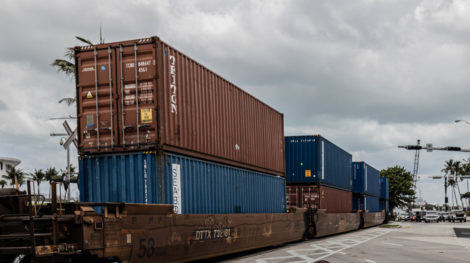
Vetting a Miami drayage carrier? Run these 10 checks — assets, UIIA, bonding, tracking, yard capacity — before you hand over your containers.
How to Choose a Drayage Carrier in Miami: 10 Checks
How to Choose a Drayage Carrier in Miami: 10 Checks
Every drayage carrier in South Florida will tell you they’re reliable. The way to find out before your container is stuck at PortMiami is to run a structured vetting process. Here are the ten checks we’d run on any carrier — including us.
1. Asset-based or broker?
Ask directly: do you own your trucks, or do you dispatch someone else’s? An asset-based carrier controls capacity, scheduling, and driver quality. A broker depends on whoever answers the phone that day. Both models can work, but you should know which one you’re buying — especially for time-sensitive moves. Go Drayage runs company-owned trucks, vans, flatbeds, and transloading equipment as part of our drayage services.
2. UIIA interchange rights
The Uniform Intermodal Interchange Agreement (UIIA) is the industry’s standard interchange contract. A carrier without current UIIA status can’t legally pull equipment from most steamship lines. Ask for proof — it’s a one-line email for a legitimate carrier.
3. Port credentials and TWIC drivers
PortMiami and Port Everglades require TWIC (Transportation Worker Identification Credential) for terminal access. Confirm the carrier’s drivers hold TWIC cards and that the company hauls at your specific terminals weekly, not occasionally.
4. Customs bonding for in-bond moves
If you move in-bond freight, IT/T&E shipments, or cargo destined for a bonded facility, your carrier needs a U.S. Customs bond. Go Drayage is licensed by U.S. Customs under bond #LBR8 — a requirement many small operators can’t meet.
5. Yard capacity behind the trucks
Drayage without a yard is a one-trick service. When your dock backs up or the LFD looms, the carrier needs somewhere secure to stage your box. Look for real capacity — our 5-acre Miami yard holds 450+ containers with 24/7 secured access and yard storage by the day or the month.
6. Real-time tracking, not check calls
“Where’s my container?” shouldn’t take three phone calls. Modern drayage carriers offer live visibility — ours runs through the Go Truck Hub TMS and a public shipment tracker. If a carrier’s tracking plan is “we’ll call you,” expect blind spots.
7. Specialized capability for your freight mix
Match the carrier to your cargo:
- Reefer: genset availability and cold-chain discipline.
- Hazmat: certified drivers and compliance memberships (COSTHA, DGAC).
- Overweight/OOG: tri-axle chassis, permits, and heavy hauling experience.
- LCL/devanning: an on-site container freight station.
8. Transparent accessorial schedule
Ask for the full fee schedule up front: chassis, pre-pull, storage, detention, hazmat, overweight. A carrier that hesitates to publish accessorials is planning to surprise you. Better yet, use an instant drayage quote calculator and see the number before you commit.
9. Insurance and safety record
Verify auto liability and cargo insurance limits that match your cargo values, and check the carrier’s FMCSA safety data. Certifications like EPA SmartWay membership signal a company that invests in its operation.
10. References that match your profile
A carrier that’s great for one importer’s five monthly boxes might struggle with fifty. Ask for references from shippers with similar volume, commodities, and delivery geography — then actually call them.
The bottom line
The cheapest quote wins until the first missed LFD wipes out a year of savings. Weigh assets, credentials, yard depth, and visibility as heavily as the rate. If you want to benchmark your current provider, contact us or call (786) 445-0150 — we’ll quote your lane and show you the yard.
Frequently asked questions
What’s the difference between an asset-based drayage carrier and a broker?
An asset-based carrier owns the trucks, chassis access, and often a yard, so it controls capacity and schedule. A broker arranges moves through third-party truckers and adds a margin without controlling execution.
Why does a drayage carrier need UIIA status?
UIIA is the standard interchange agreement with ocean carriers and equipment providers. Without it, a trucker generally cannot pick up or return steamship-line containers and chassis at the terminals.
Do all Miami drayage drivers need TWIC cards?
Any driver entering secure areas of PortMiami or Port Everglades needs a TWIC card. Carriers without TWIC drivers must hand your freight to someone else — adding cost and risk.