


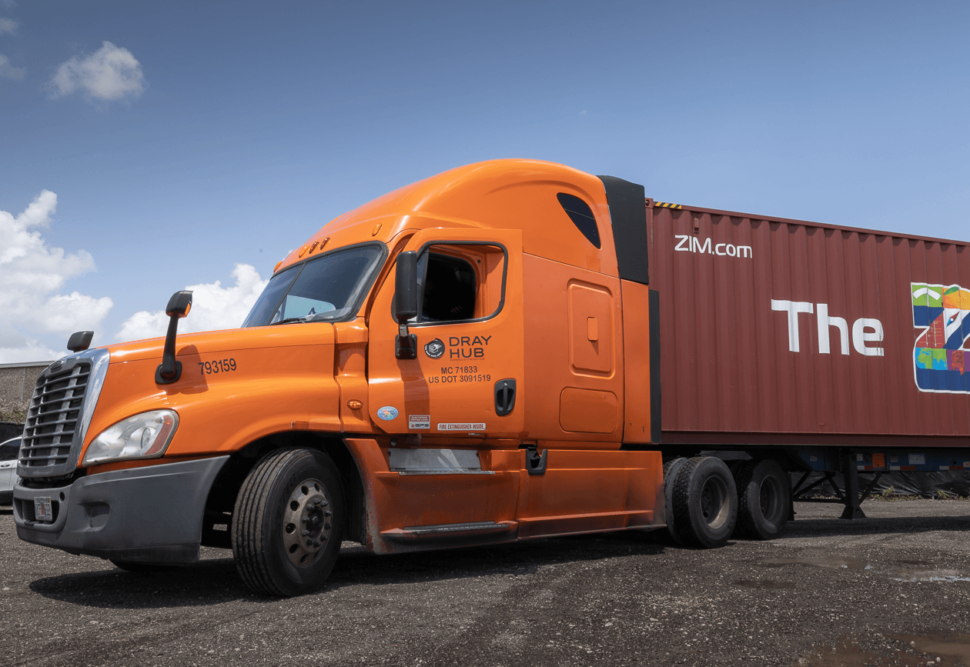
Not every container discharged in South Florida is destined for South Florida. A steady share of PortMiami and Port Everglades volume ends up in Orlando, Lakeland, Tampa and the I-4 corridor — distribution centers, theme park supply chains, building products, and a growing base of e-commerce fulfillment.
That move is technically drayage, but it behaves differently from a 20-mile run to Medley. The distance changes the equipment math, the free time math, and often the answer to whether the cargo should stay in the container at all.
The distances involved
From PortMiami, Orlando is roughly 235 miles up the Florida Turnpike or I-95 to I-4. Tampa is roughly 280 miles, generally via the Turnpike to I-4 westbound or across Alligator Alley and up I-75. Port Everglades shaves about 25 miles off both. Lakeland and Winter Haven sit between the two, around 200 to 230 miles.
Practically, all of these are single-day round trips only in favorable conditions. A live unload in Orlando with a morning terminal pickup is achievable; the same trip to Tampa with an afternoon appointment is not. That single fact drives most of the cost structure.
What makes long-haul drayage cost what it costs
Driver hours, not just miles
A 235-mile leg each way plus terminal queue time plus unload time bumps against hours-of-service limits. If the driver cannot legally complete the round trip, the move either requires an overnight — which you pay for — or a relay. This is why quotes to Central Florida don’t scale linearly from local rates.
Equipment tied up longer
A local container might turn three times in a day. An Orlando run occupies a tractor, a chassis and a driver for one turn or more. Chassis per diem accrues for the whole period, and if you’re using a pool chassis outside its home region, availability and return logistics get more complicated. Our chassis guide covers how those fees stack.
The empty return leg
Here’s the part that surprises people. The empty container almost always has to come back to South Florida, because that’s where the ocean carrier’s depots are. So a Miami-to-Orlando drayage move is really Miami to Orlando to Miami — a round trip of roughly 470 miles — and per diem runs the entire time. If the receiver takes two days to unload, you have paid for a long move and then paid detention on top of it.
Tolls and route
The Turnpike is the fast route and it is tolled the whole way. Alligator Alley is tolled. These are real line items on a long move, and a bid that doesn’t state how tolls are handled is an incomplete bid.
The transload question
For most Central Florida destinations, the honest analysis is: should the container go at all?
The alternative is to pull the container from the terminal, strip it at a facility near the port, load the cargo onto a 53-foot domestic trailer, and run that trailer to Orlando or Tampa. The advantages are substantial:
- The empty goes back the same day. Per diem stops in hours instead of days. This alone often covers the transload cost.
- More cargo per trailer. A 53-foot dry van holds meaningfully more than a 40-foot container, so on volume moves you may run three trailers where you would have run four containers.
- No chassis on the long leg. No chassis per diem, no split risk, no roadability exposure across 470 miles.
- Domestic trucking capacity. The I-4 corridor is thick with dry van capacity; port drayage capacity is thinner and more expensive per mile.
The tradeoffs are equally real: an extra handling of the freight (with the damage risk that implies), an extra day in transit, and a cost that only pencils out above a certain volume or dwell time. For a single container going straight to a receiver who unloads on arrival, direct drayage usually wins. For steady volume, or for cargo that will sit, transloading usually wins. Our Miami transloading guide works through the arithmetic, and the transloading vs. cross-docking post clarifies which service you’re actually asking for.
Planning a Central Florida move that doesn’t go sideways
Work backward from last free day. On a long-haul move you need more buffer, not less, because a single missed appointment can push the whole trip a day. Know your last free day the moment the vessel discharges.
Confirm the receiving end before dispatch. Appointment window, dock hours, whether they’ll accept a drop or require a live unload, whether they have equipment to unload a container versus a trailer, and whether their yard can even accommodate a 40-foot box on a chassis. A truck that arrives in Lakeland to find a two-hour wait has burned the driver’s remaining hours.
Decide drop-and-hook or live unload explicitly. On long moves, a live unload that runs over turns into an overnight. If the receiver can take a drop, take it. Our drop-and-hook comparison covers the tradeoffs.
Use a yard as a buffer. Pulling the container off the terminal into an off-dock yard the day it becomes available stops demurrage and lets you dispatch the long leg when the receiver is actually ready, rather than racing the terminal clock.
Consider the rail option for volume. For sustained Central Florida volume, intermodal rail from South Florida can compete on cost, with drayage on both ends. Our post on rail ramp drayage in Florida covers how those moves work.
Getting a real number
Long-haul drayage quotes vary widely because the assumptions vary widely — tolls, chassis, wait time, overnight, empty return. When you ask for pricing, give the delivery ZIP, the container size and weight, the expected unload method, and how many days the box will be at the receiver. A quote built on those inputs will survive contact with the invoice. Request a drayage quote or talk to our team about your Central Florida lanes.
Frequently asked questions
Is it cheaper to dray a container to Orlando or transload near the port?
It depends on volume and dwell. For one-off containers unloaded immediately on arrival, direct drayage is usually simpler and cheaper. For regular volume, or when the box will sit at the receiver for more than a day, transloading near the port often costs less overall because the empty returns the same day and per diem stops.
Can a container go from PortMiami to Tampa and back in one day?
Rarely. Roughly 280 miles each way plus terminal queue and unload time generally exceeds what a driver can legally complete in a single duty period. Plan for an overnight, a relay, or a drop at the receiver with the empty recovered on a later trip.
Does per diem keep running while my container is in Orlando?
Yes. Detention and per diem on a carrier-owned container run until the empty is returned to an accepting depot, which for South Florida imports is normally back in the Miami or Fort Lauderdale area. The travel time in both directions counts.