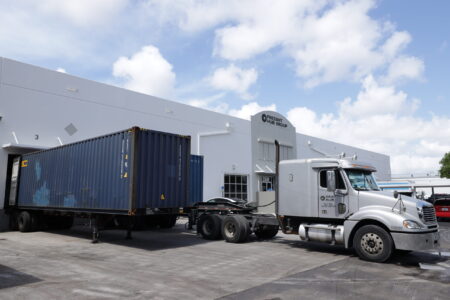
Cargo arrived damaged after the drayage leg? Here is how liability is decided, what to document at the dock, and how to file a claim that does not get denied.
Cargo Damage on a Drayage Move: How Claims Actually Work
Cargo Damage on a Drayage Move: How Claims Actually Work
Most containers arrive intact. When one does not, the question of who pays gets decided by paperwork created in the first ten minutes at the dock — long before anyone thinks about filing a claim. This is what that process actually looks like on a South Florida import move.
First: was the drayage leg even involved?
A drayage carrier picks up a sealed container at the terminal and delivers it sealed. The driver does not load it, does not open it, and in most cases has no idea what is inside beyond the description on the delivery order. That narrows liability considerably.
The seal is the pivot point. If the container arrives with the original seal intact and the number matches the one on your bill of lading, the trucker did not access the cargo. Damage found inside a sealed box almost always traces to stuffing at origin, vessel movement, or handling at the terminal. Our guide to container seals and ISO 17712 explains what to check and why the number matters more than the seal’s condition.
The drayage leg genuinely is in play when: the seal is broken or mismatched on arrival, the container was tipped or involved in a road incident, the box was left unattended somewhere it should not have been, or the cargo was handled during a transload where the carrier did touch the freight.
What to do at the dock, in order
- Photograph the seal before anyone touches it. Get the number legible in the frame, and a wide shot showing it attached to the door.
- Compare the number to your documents. Mismatch is a finding in itself — note it on the delivery receipt immediately.
- Photograph the container exterior. Dents, punctures, roof damage, water staining, door gasket condition.
- Open and photograph the load in place before unloading. A picture of collapsed stacking is worth far more than a picture of the same cargo on the warehouse floor.
- Write the damage on the delivery receipt and have the driver sign it. “Subject to inspection” is not enough; describe what you see. A clean signed receipt is the single most common reason claims get denied.
- Keep the packaging. Adjusters ask for it, and discarding it before inspection can kill an otherwise valid claim.
If damage only appears once the pallets are broken down — concealed damage — note the discovery date and photograph everything the moment you find it. Concealed damage claims are harder, not impossible, and the gap between delivery and discovery is what the adjuster will attack.
Who the claim actually goes to
There are usually three candidates, and they are not mutually exclusive:
The motor carrier
Liable under the Carmack Amendment for loss or damage occurring while the goods were in its possession, subject to the limits in its tariff and your rate agreement. This is the right target when the damage is clearly road-related.
The ocean carrier or terminal
Liable for damage during the water leg or terminal handling, under COGSA, which carries a package limitation that is often far below the cargo’s real value. Notice deadlines here are short — frequently three days for non-apparent damage.
Your own cargo insurance
Marine cargo insurance covers the goods regardless of who caused the damage, then subrogates against whoever is responsible. For high-value freight this is the practical route, because it pays on actual value rather than a liability limit. See what cargo insurance covers in drayage for how the two layers interact.
Cargo damage vs. equipment damage
These are separate processes and people confuse them constantly. Damage to the container or chassis is handled through the interchange system — the EIR signed in and out of the terminal establishes what condition the equipment was in at each handoff. That is covered in our guide to interchange receipts and equipment damage claims. Damage to your goods is a cargo claim, which is what this article is about.
Filing the claim
A claim that gets paid contains, at minimum: the bill of lading and delivery receipt with the damage notation, dated photographs, a commercial invoice establishing value, a repair estimate or evidence of salvage value, and a clear statement of the amount claimed. Vague claims get slow-walked; documented claims get adjusted.
Send it in writing to the carrier’s claims contact, not to your dispatcher. Keep a copy. Expect an acknowledgment within thirty days and a decision within one hundred twenty days — those are the federal benchmarks for motor carriers.
Preventing the next one
Most recurring damage is a loading problem at origin, not a trucking problem. If the same supplier’s containers keep arriving with shifted loads, the fix is better blocking and bracing at stuffing, not a different carrier. If the damage pattern follows a particular route or receiver, that is worth a conversation about delivery access — see our notes on how your receiving dock affects the move.
And keep the paperwork habit. The photo you take in thirty seconds at the dock is the evidence you will wish you had four months later.
Questions about how we document interchanges and deliveries on your freight? Get in touch.
Frequently asked questions
How long do I have to file a cargo claim against a motor carrier?
Under the Carmack Amendment the minimum window carriers must allow is nine months from delivery to file a written claim, and two years from claim denial to file suit. Many carrier contracts set shorter notice requirements for visible damage, sometimes as little as the day of delivery, so check your rate agreement.
What if the damage was already there when the container was opened?
Then it likely happened at origin, on the vessel, or at the terminal, not on the drayage leg. A sealed container that arrives with an intact, matching seal is strong evidence the trucker never had access to the cargo. That is why checking the seal number before the doors open matters.
Does the drayage carrier’s cargo insurance cover the full value of my goods?
Usually not. Motor carrier cargo policies carry a per-load limit, commonly in the $100,000 range for drayage, and marine cargo insurance is what covers full commercial value. If your container is worth more than the carrier’s limit, you need your own cargo policy.