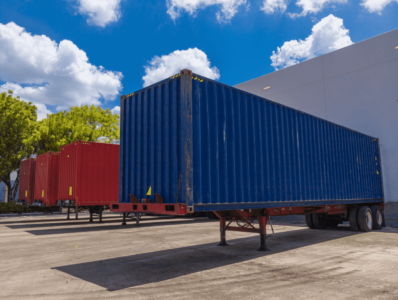
Outgrown your 3PL’s inbound handling? How e-commerce brands importing through South Florida take control of container drayage, transloading and storage.
When Your E-Commerce Brand Outgrows Its 3PL’s Inbound Handling
When Your E-Commerce Brand Outgrows Its 3PL’s Inbound Handling
For the first couple of years, inbound is somebody else’s problem. Your freight forwarder quotes door-to-door, the container appears at your fulfillment center, and you never think about the port.
Then volume grows, and the cracks appear. Demurrage charges you did not expect. Containers arriving when the 3PL cannot receive them. Stockouts because a shipment sat at the terminal for five days while nobody told you. A door-to-door rate that has quietly become the largest unexamined line in your landed cost.
At that point the inbound leg is worth owning directly.
What changes as you scale
Your forwarder’s door rate stops being competitive. Bundled door-to-door pricing includes a drayage leg the forwarder buys and marks up. At low volumes that convenience is worth the margin. At higher volumes you are paying a premium for a phone call.
Your 3PL’s receiving becomes the constraint. Fulfillment centers are optimized for outbound. Inbound container receiving is often limited to certain days, certain hours, and a certain number of containers. When you are sending one box a month, you fit. When you are sending six a week, you queue.
Demurrage stops being an anomaly. With enough containers, the probability that one hits a hold, a bunched vessel or a full receiving calendar approaches certainty. Our guide to demurrage, detention and per diem covers which clock is which.
Nobody owns the visibility gap. The forwarder’s job ends at delivery. The 3PL’s begins at receipt. The days in between — the days that actually determine whether you stock out — belong to nobody.
The structural fix: decouple arrival from receipt
The single most useful change is to stop treating “container discharged” and “inventory received” as the same event.
Right now they are chained: the container must go from terminal to 3PL, and if the 3PL cannot take it today, the container waits at the terminal on a clock. Inserting a buffer breaks that chain.
Yard storage gets the box off the terminal and stops the demurrage clock, then delivers into the 3PL’s schedule rather than fighting it. Our yard storage and off-dock container storage pages cover how this works.
Transloading goes further: the container is stripped and the goods move onto trailers. This lets you split one container across several delivery days, send different SKUs to different locations, or feed a 3PL that would rather receive palletized freight than a live container unload. See our container transloading guide and the container freight station service.
Pre-pulls handle the specific case where free time is about to expire and the receiving date is fixed. Covered in what is a container pre-pull.
Why South Florida specifically
If your goods come from Latin America or the Caribbean, or transship through the region, PortMiami and Port Everglades are natural entry points with short inland legs to the Miami-Dade and Broward warehouse clusters. Compared with routing everything through a West Coast gateway and railing across, the drayage leg is short and the transit is predictable.
The trade-off is that South Florida’s warehouse market is tight and the dense industrial zones — Medley, Hialeah, Doral, Airport West — have their own access and appointment realities. Our guides to Miami drayage delivery zones and Medley and Hialeah warehouse drayage cover the local picture.
If you are importing for Amazon FBA specifically, the appointment and labeling constraints are their own topic — see drayage for Amazon FBA imports.
What to put in place
- Get container-level visibility. You need to know the vessel, the availability date and the last free day for every box, not a forwarder’s summary. Real-time tracking is table stakes — see our shipment tracker.
- Establish your 3PL’s real receiving capacity. Containers per day, hours, appointment lead time, live unload versus palletized. Design around the truth, not the sales deck.
- Contract drayage directly. Even keeping your forwarder for ocean, buying the inland leg separately gives you visibility and removes a markup.
- Build a buffer plan before peak. Decide now whether overflow goes to yard storage or transloading. Our peak season guide covers the pattern.
- Track landed cost per container, including accessorials. The demurrage and detention you are absorbing may be larger than the rate difference you have been optimising.
Why an asset-based partner fits this stage
A growing brand’s inbound problem is variability — some weeks two containers, some weeks nine. Handling that requires trucks, chassis and somewhere to put things, controlled by one party.
Go Drayage is an asset-based 3PL running company-owned trucks, vans, flatbeds and transloading equipment from a 5-acre yard in Miami with 24/7 access, capacity for around 450 containers, and U.S. Customs bonded status. Drayage, transloading and storage sit under one roof, which is precisely what decoupling arrival from receipt requires.
If your inbound has outgrown a door-to-door rate, request a quote with your container volume and destination, or contact the team.
Frequently asked questions
Should I still use my freight forwarder if I contract drayage directly? Many brands do exactly that — keep the forwarder for ocean freight and customs coordination, and contract the inland leg separately. You get visibility and remove a markup on the drayage portion without rebuilding your whole import process.
My 3PL can only receive two containers a week. What are my options? Decouple arrival from receipt. Pull containers off the terminal into yard storage so the demurrage clock stops, then feed them to the 3PL on its schedule. If the 3PL prefers palletized freight, transloading lets you convert one container into deliveries spread across several days.
Is it cheaper to import through South Florida than the West Coast? It depends entirely on origin and destination. For goods originating in or transshipping through Latin America and the Caribbean, and for inventory serving the eastern US, South Florida often means shorter inland legs and more predictable transit. For Asia-origin goods serving western markets, it usually does not. Compare total landed cost and transit variability, not ocean rate alone.