

The first container is expensive in ways nobody warns you about. Not the freight – the freight was quoted. It is the customs bond you did not know you needed, the four days of demurrage while you found a trucking company, the chassis charges nobody explained, and the discovery on delivery day that a 40-foot container will not fit down your street.
None of that is unusual and none of it is necessary. Here is the sequence that experienced importers follow, in the order it has to happen.
Before you place the order
Decide who the importer of record is
Someone has to be legally responsible for the entry, the duties and the accuracy of the declaration. Usually that is your company. If your supplier is offering DDP terms where they act as importer of record, understand that this is unusual for US imports and often signals a pricing structure worth examining.
Get an EIN or importer number
US Customs identifies importers by an IRS number, and your broker will need it to file. If your company is new, this is the first step and it is not instant.
Choose a customs broker before you need one
A licensed customs broker files your entry, classifies your goods, and calculates duty. Pick one early and give them your product details so classification questions get resolved before the container is on the water, not after. Our explanation of what a customs broker does vs. a drayage carrier clarifies the split, because new importers often assume one company handles both.
Get a customs bond
Almost every commercial import requires a bond. A single-entry bond covers one shipment; a continuous bond covers a year and is usually cheaper if you will import more than a few times. Your broker can arrange either. Do not discover this requirement on arrival day.
Before the vessel sails
File the ISF – and file it on time
Importer Security Filing, sometimes called 10+2, must be filed before the cargo is loaded at origin. Late filings draw penalties and can trigger holds. Your broker files it, but they need data from you and your supplier, which takes longer than you expect the first time. See our ISF filing and pickup timing guide.
Confirm your Incoterm in writing
FOB, CIF and DAP put the destination truck move in very different hands. If your term ends at the port, you are booking the drayage – so know that now, not later.
Ask how much free time you get
Free time at the terminal is set by your ocean carrier. Three to five days is common but it varies, and it can be negotiated on volume. Write the number down. It becomes your deadline.
Two weeks out
Line up a drayage carrier
Do this before the vessel arrives. A carrier needs your delivery address, receiving hours, whether you have a dock or need a live unload at ground level, container size, commodity, and whether the cargo is hazardous or temperature-controlled. Setting up a new account on the day the container lands is how importers end up paying demurrage.
Check that your site can physically take a container
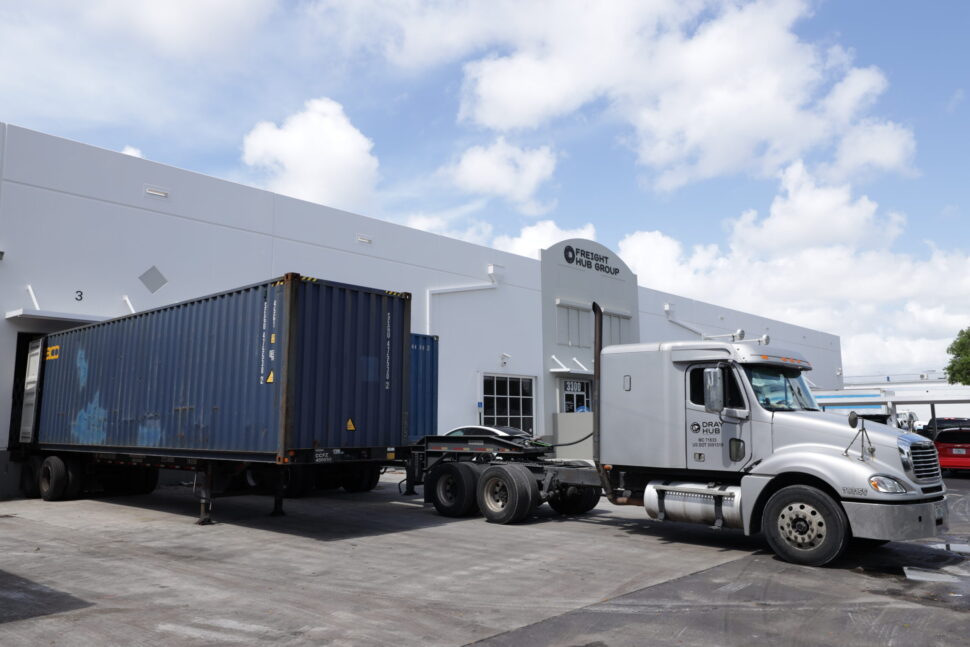
A tractor with a 40-foot container on a chassis is roughly 65 to 70 feet long and needs room to swing. Confirm:
- Can a semi turn into and out of your property?
- Is there a dock at trailer height, or will the container be unloaded at ground level?
- Do you have a forklift, and is it rated for your heaviest pallet?
- Are there overhead restrictions – awnings, power lines, low branches?
- Does your landlord or HOA restrict commercial deliveries?
If the answer to any of these is uncomfortable, plan a transload instead: the container is stripped at a facility near the port and the goods are delivered on a smaller truck. Our transloading guide explains how that works.
When the arrival notice lands
This is the document that starts your clock. From it, extract and act on four things:
- The discharge terminal – your carrier needs it to dispatch.
- The last free day – the date demurrage starts.
- Any holds – customs, freight (unpaid ocean charges), USDA or FDA. A container with a hold cannot be picked up regardless of free time.
- The amount due to the ocean carrier – unpaid freight creates a freight hold, which is the most common self-inflicted delay.
Send the terminal, container number and last free day to your drayage carrier the same day. If your dock is not ready, ask about a pre-pull to yard storage – terminal demurrage is typically far more expensive per day than yard storage.
Delivery day
Have someone on site who can sign, and have them check three things before signing clean: the container number matches your paperwork, the seal number matches and the seal is intact, and there is no visible damage to the box. If anything is off, photograph it and note it on the delivery receipt. A clean signature on a damaged container makes a later claim very difficult.
Then unload promptly. The container has to go back, and container per diem starts when free time ends – a separate clock from terminal demurrage.
What the first container typically costs beyond the freight
Build your landed-cost model with all of these, not just ocean freight:
- Duties and any applicable tariffs
- Customs bond and broker entry fee
- Destination terminal handling
- Chassis
- Drayage, plus any accessorials such as waiting time or an overweight surcharge
- Demurrage and per diem if you miss a clock
- Exam fees if selected – these are not rare
Getting a drayage quote early lets you plug a real number into that model instead of a guess.
Frequently asked questions
How long do I have to pick up my container before charges start?
Free time is set by your ocean carrier and commonly runs a few days from the date the container is available, though it varies by carrier and contract. Confirm the exact last free day on your arrival notice and treat it as a hard deadline, because demurrage accrues per container per day after it.
Do I need a customs broker, or can I file the entry myself?
You may file your own entries, but for a first-time importer it is rarely worth it. Classification errors, valuation questions and missed filing deadlines cost far more than a broker’s fee. Most importers use a broker permanently.
What if my warehouse cannot receive a 40-foot container?
Use a transload. The container is stripped at a facility near the port and your goods are delivered on box trucks or smaller trailers that fit your site. It adds a handling cost but removes the access problem and usually gets the container back faster, which reduces per diem.