


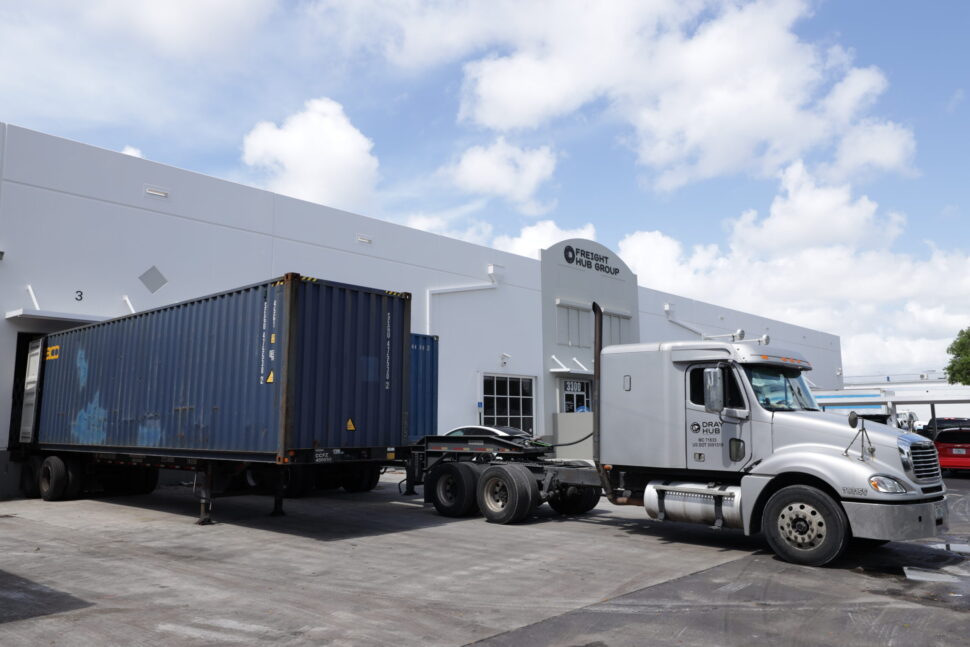
When you need a container pulled from PortMiami or Port Everglades, you can hire two very different kinds of company, and they are often hard to tell apart from the outside. Both have a website. Both quote in dollars per move. Both call you back. But one owns trucks and one owns a phone list, and that difference shows up on the day your container is stuck.
What each one actually is
An asset-based drayage carrier holds motor carrier authority, owns or leases the tractors, employs or contracts the drivers, and carries its own liability and cargo insurance. When it moves your box, its name is on the interchange and its insurance is on the load.
A freight broker holds broker authority. It does not own trucks. It takes your shipment, finds a motor carrier willing to run it, and keeps the difference between what you pay and what the carrier accepts. Brokers are legitimate and useful, and a good one adds real value. But the physical move is always performed by somebody else.
There is also a hybrid: carriers that run their own fleet and broker overflow when their trucks are committed. That is normal and usually fine, as long as they tell you when a move is going to a partner carrier.
Where the difference shows up
Control on a bad day
Most drayage moves are uneventful. The ones that are not — a terminal appointment that evaporates, a chassis split, a customs exam, a receiver who closed early — are where the two models diverge. A carrier with its own dispatch can re-route a driver, pull a second truck off another job, or drop the box in its yard for the night. A broker has to call its carrier and hope that carrier has slack.
Who answers for the cargo
If cargo is damaged, the claim runs against the motor carrier’s insurance. With a carrier you have one counterparty. With a broker you have a broker, a carrier you may never have spoken to, and a longer paper trail. Read our guide to cargo insurance in container drayage for what is actually covered either way.
Consistency of equipment and drivers
Steady volume through one carrier means the same drivers learn your receiver’s gate, your unload window, and your paperwork quirks. Brokered freight rotates through whoever bid lowest that week. For a warehouse with a tight dock or a tricky approach, that matters more than most shippers expect.
Rate behavior over time
Broker pricing tracks the spot market closely — good when capacity is loose, painful in peak season or after a storm. Carrier pricing tends to move more slowly in both directions. Neither is universally cheaper; they are cheaper at different moments.
When a broker is the right call
- One-off moves in a market where you have no carrier relationship.
- Lanes far outside your normal geography, where finding a local carrier yourself is not worth the time.
- Highly variable volume with no predictable pattern.
- Specialty equipment you need once a year and no local carrier keeps on hand.
When an asset-based carrier is the right call
- Recurring container volume through the same ports.
- Cargo with real consequences if it sits: perishables, retail with on-time-in-full penalties, production inputs.
- Any situation where you need yard space, a pre-pull, or overnight storage as part of the plan rather than an emergency.
- Accounts where you want one phone number and one invoice to argue with.
The South Florida angle
PortMiami and Port Everglades are appointment-driven, and appointment slots are a scarce resource. Carriers that run volume through both terminals daily hold standing positions in the appointment systems and know which windows actually clear. A broker’s carrier of the day starts that process from zero. In a market where free time is short and demurrage accrues fast, that head start is worth money — see how last free day works for why the clock is unforgiving.
The same logic applies to empties. Returning an empty in South Florida can mean a rejected appointment and a second trip. A carrier with its own container yard can park the box and try again without billing you for a dry run. A brokered truck cannot.
Questions that separate the two in about ninety seconds
- Do you own the trucks that will move my container, or will this be tendered out?
- What is your MC number, and is that broker or motor carrier authority?
- Where is your yard, and can you hold a container overnight?
- Who do I call at 6 p.m. when the receiver refuses the delivery?
- Are your drivers TWIC-credentialed and UIIA-registered at both ports?
Straight answers to those five mean you know what you are buying. Evasive answers mean you are buying a phone call.
Making the call
This is not a moral question. Brokers solve a real problem for shippers with scattered, unpredictable freight. But if your containers come through the same two ports every month and land at the same warehouses, you are paying a margin for a service you could buy direct — and giving up control on exactly the days you need it most. Our carrier selection checklist covers how to vet the direct option.
If you want to see what direct pricing looks like for your lanes, request a drayage quote and compare it against what you are paying now.
Frequently asked questions
Is a freight broker cheaper than a drayage carrier?
Sometimes on a single move, because a broker can shop the load to whoever has a truck sitting idle that day. Over a year of steady volume, an asset-based carrier is usually cheaper and steadier, because you are not paying a margin on top of the trucking cost and you are not re-bidding the same lane every week.
Can a freight broker legally haul my container?
No. A broker arranges transportation; it does not own trucks or employ drivers. The motor carrier whose authority and insurance are on the move is the one that actually hauls it. That distinction matters when something goes wrong.
How do I tell which one I am talking to?
Ask for the MC number and whether it is broker authority or motor carrier authority, then look it up in the FMCSA SAFER system. Ask who owns the trucks and whether the drivers are employees. A carrier answers those questions immediately.